
Introduction
Altar textiles play not only a practical but also a symbolic role in the liturgy.
What the altar is covered with influences the perception of the presbytery space, emphasizes the nature of the celebration, and expresses respect for the place where the Eucharist is celebrated.
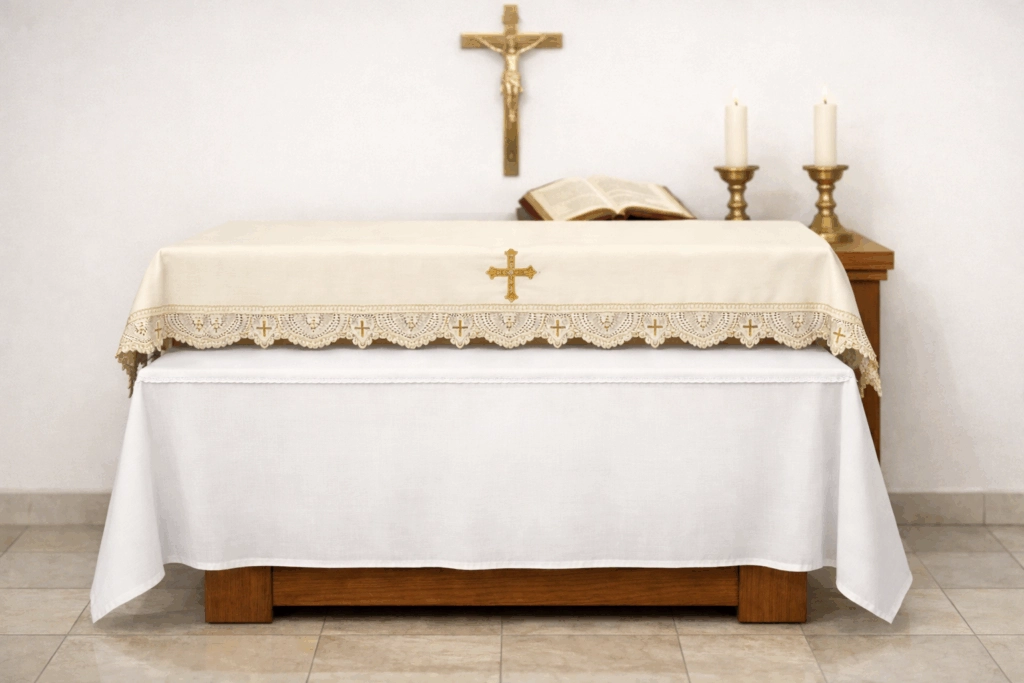
Although all these elements are commonly referred to as “tablecloths,” the Church uses several different types of coverings, each with its own function. In this article, we describe the differences between a tablecloth, a napkin, and an altar covering, and indicate when each type of textile is used.
1. Altar cloth — the basic covering for the mensa
The altar cloth is the most classic and liturgically “mandatory” form of covering.
Its characteristics:
- it covers the entire mensa,
- it is always white,
- it symbolizes the purity and dignity of the altar,
- it forms the basic layer under the other elements.
In the tradition of the Church, the tablecloth plays a role similar to that of a banquet tablecloth — it reminds us of the Eucharistic feast in which the community participates.
Use:
→ every Holy Mass, all chapels and churches.
2. Altar cloth — smaller form, greater precision
The altar cloth is a smaller covering placed:
- in the center of the altar,
- under the liturgical vessels,
- as a supplement to the main altar cloth.
It is most often decorated with:
- delicate Eucharistic embroidery,
- floral motifs,
- discreet symbolic ornamentation.
The altar cloth serves mainly an aesthetic and practical function — it protects the tablecloth from dirt and creates a clear space around the liturgical vessels.
Use:
→ Daily Masses, celebrations in chapels, smaller altars.
3. Altar cover — decorative layer
The altar cover (overlay) is a decorative element that is placed on top of the tablecloth, especially during solemn periods.
It differs from a tablecloth in that it has:
- a larger surface area,
- richer decoration,
- a more impressive format.
The altar cover allows special moments of the liturgical year to be marked.
They are often decorated with:
- Eucharistic motifs,
- symbols of the liturgical season,
- elegant floral ornaments.
Use:
→ ceremonies, holidays, adorations, celebrations of a particularly solemn nature.
4. Symbolism of altar textiles
All forms of altar coverings have one thing in common—their function is to express respect for the Eucharist.
The symbolism is subtle but clear:
- white — purity, joy, holiness,
- Eucharistic embroidery — emphasizing the essence of the celebration,
- floral motifs — growth, life, harmony,
- cross ornaments — the center of the mystery of faith.
In the liturgy, beauty is not an addition — it is a tool for prayer.
5. How to choose the right altar covering?
A few practical rules:
- the tablecloth should always be the base,
- the altar cloth should match its style,
- the covering may emphasize the solemn nature of the period,
- the embroidery should not overwhelm, but harmonize,
- the proportions of the fabric must correspond to the scale of the altar.
A covering that is too small or too large disturbs the elegance of the presbytery.
6. The aesthetics of contemporary altar textiles
Today’s altar coverings combine traditional symbolism with a modern approach to form.
The following are valued:
- simplicity,
- a clear axis of composition,
- elegant embroidery,
- delicate, harmonious details.
This style allows the beauty of the liturgy to be preserved without excessive decoration.
Summary
The tablecloth, altar cloth, and altar covering play different but complementary roles in the liturgy.
Together, they create an elegant and theologically coherent setting for the place where the Eucharist is celebrated.
Choosing the right textile covering is not an aesthetic decision—it is an expression of concern for the beauty of the sacred space.