
Introduction
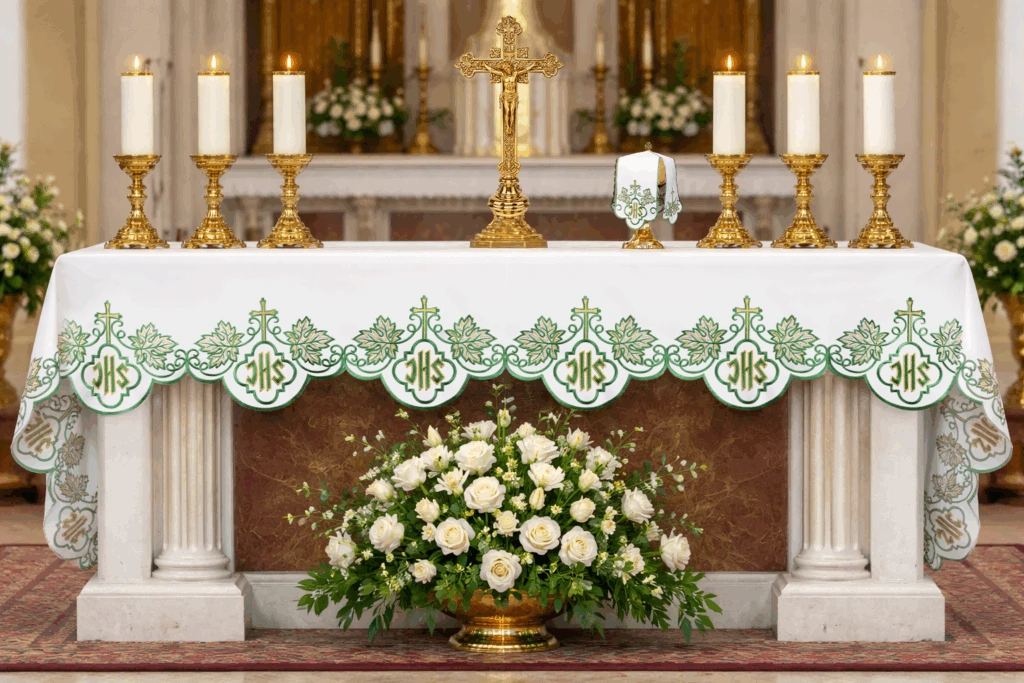
The altar is the center of the Eucharistic celebration—the place where the Church’s most important prayer takes place. The altar cloth is therefore not a decorative element, but a sign of respect for what is sacred. Its presence is deeply rooted in liturgical tradition, and its form and decorations convey a clear message about the dignity of the place where the Holy Sacrifice is celebrated.
In this article, we discuss the symbolism of the tablecloth, its practical function, and contemporary aesthetic principles.
1. The altar cloth in the tradition of the Church
From the earliest centuries of Christianity, the altar was covered with a cloth that emphasized its uniqueness. Initially, these were natural fabrics—often plain and simple—later more decorative forms appeared, based on patterns known from sacred art.
Tradition dictates the use of a white tablecloth as a sign of purity and respect.
Contemporary altar cloths preserve this principle, combining it with elegant designs and motifs referring to the Eucharist.
2. The function of the altar cloth
The altar cloth has two roles: symbolic and practical.
Symbolic:
- it emphasizes the dignity of the altar,
- it reminds us of the Eucharistic “feast,”
- it is a sign of purity, respect, and readiness for celebration.
Practical:
- it protects the altar table from damage,
- it protects against wine or oil spills,
- it provides a stable base for books, vessels, and chalice linens.
A well-chosen altar cloth is one of the most important elements of the presbytery’s furnishings.
3. Types of altar coverings
Although they are commonly referred to as “tablecloths,” there are different forms of coverings:
Altar tablecloth
The basic covering that covers the entire mensa.
Sometimes decorated with embroidery on the front, sometimes kept in elegant simplicity.
Altar cloth
A smaller form, used as an overlay on the main tablecloth or in chapels.
Usually decorated with a delicate Eucharistic or floral motif.
Altar cover (overlay)
A decorative element placed over the basic tablecloth, often with richer decoration.
It emphasizes the solemnity of liturgical periods and important celebrations.
All three forms serve the same function — they differ in scale and purpose.
4. Symbolism of decorations
The decorations have their own theology:
- Eucharistic motifs — chalice, host, vine,
- crosses and Christ ornaments — emphasize the centrality of the mystery,
- floral motifs — vine leaves, olive branches, flowers with symbolic meaning.
The symbolism should be discreet — liturgical elegance is based on harmony, not splendor.
5. How to choose a tablecloth for the interior of a church?
A well-chosen tablecloth should harmonize with:
- the color of the walls and lighting of the presbytery,
- the architecture of the altar,
- the style of other textile elements (napkins, tablecloths, chalice linens).
Modern aesthetic trends focus on clean lines, smooth motifs, and precise decoration that does not dominate but complements the sacred space.
6. Dimensions and fit
Altars vary in design, so the tablecloth should have the right proportions:
- length and width adjusted to the mensa,
- harmonious overhang of fabric on each side,
- appropriate scale of the pattern (the embroidery should not be too small or overwhelming).
Liturgical aesthetics are based on calm proportions.
7. How to care for altar tablecloths?
- wash gently, preferably at a low temperature,
- dry flat to avoid deformation,
- iron with care, especially in areas with decorations,
- store flat or rolled up to avoid sharp creases.
An elegantly maintained tablecloth is a sign of care for the liturgy and the community.
Summary
The altar cloth is one of the most symbolic elements of the presbytery’s furnishings. It combines tradition, practicality, and aesthetics, emphasizing the dignity of the place where the Eucharist is celebrated. Its form—clear, harmonious, and liturgically subdued—introduces a beauty that helps the faithful enter into prayer.