
Introduction
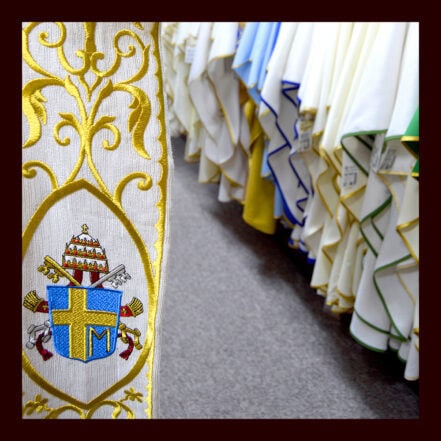
Nothing in the liturgy is accidental. Every gesture, sign, and detail has a specific role to play. Liturgical embroidery, though subtle, is one of the most beautiful forms of theological expression. The decorations on chasubles, copes, stoles, and shoulder veils are not merely aesthetic; they are primarily a vehicle for symbolism and a continuation of a tradition that has developed in the Church over centuries.
In this article, we look at the meaning of liturgical embroidery and how its form influences the perception of priestly vestments.
1. What is liturgical embroidery?
Liturgical embroidery is decoration made with the utmost precision to emphasize the sacred nature of the vestment.
In liturgy, the following are important:
- elegance,
- proportion,
- harmony of detail,
- theological clarity of the symbol.
Embroidery is one of the oldest ways of decorating vestments, found in the Church as early as the first centuries.
It is a form of art that combines tradition with craftsmanship.
2. Symbolism of the most important motifs
The symbolism of embroidery is rich and varied, but it constantly refers to the Holy Scriptures and the tradition of the Church.
IHS
One of the oldest Christograms.
It emphasizes that the Eucharist is the center of the Church’s life.
The chalice and the host
A symbol of the Eucharist, sacrifice, and the real presence of Christ.
Cross
A key motif—it expresses Passover, victory, and salvation.
Lamb
A reference to the Paschal Lamb and the sacrifice of Christ.
Vine and ears of grain
A reminder of the gifts offered to God and the unity of the Church.
Marian motifs
Lilies, stars, monograms — a gentle accent emphasizing Mary’s presence in the history of salvation.
Each of these motifs is not only a decoration, but also a visual catechesis.
3. The role of embroidery in liturgical vestments
Liturgical embroidery plays several important roles:
It beautifies the vestment
But always in a spirit of harmony and moderation.
The liturgy does not like exaggeration — it likes beauty that leads to concentration.
It teaches through symbols
The faithful instinctively read symbols.
Well-made embroidery makes the vestment a tool for catechesis.
It emphasizes the liturgical season
Motifs appropriately matched to the color of the vestment create a coherent whole.
It gives character to the celebration
A richly decorated chasuble emphasizes solemnity, while delicate embroidery emphasizes silence and simplicity.
4. Contemporary aesthetics of liturgical embroidery
Today’s liturgical workshops combine traditional techniques with contemporary design.
The following dominate:
- elegant lines,
- symmetry,
- motifs with clear meanings,
- delicate golden accents,
- refined floral compositions.
Embroidery is an art of precision. Every detail, even the smallest, must be made with attention to proportion and consistency.
5. Placement of embroidery on priestly vestments
Embroidery should:
- reinforce the central axis of the chasuble,
- emphasize the vertical line of the vestment,
- maintain an elegant scale,
- not disturb the silhouette of the celebrant.
It is most often placed:
- on the column of the chasuble,
- on the collar,
- on the stole,
- on the front of the shoulder veil,
- on the panel of the cope.
This preserves liturgical clarity and harmony.
6. Care for liturgical embroidery
Embroidery requires protection:
- avoid friction,
- clean gently,
- store the vestment in a hanging position,
- protect from moisture and light.
Well-maintained embroidery retains its luster for many years, and the liturgical vestment does not lose its elegance.
Summary
Liturgical embroidery is an art that combines theology, symbolism, and aesthetics.
It is not decoration in the secular sense—it is a tool of prayer and beauty leading to God. Refined detail, harmonious composition, and elegant motifs make the priestly vestment a clear sign of the liturgy.