
Introduction
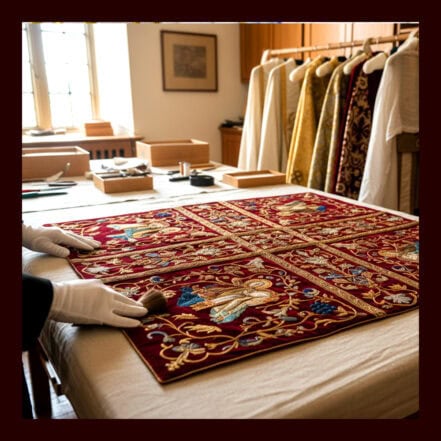
Liturgical vestments play a unique role—they accompany the celebrant during the most important moments of the Church’s prayer. Their beauty and condition are not only a matter of aesthetics, but also an expression of respect for the Eucharist. Caring for chasubles, stoles, copes, dalmatics, and shoulder veils is a practice that combines technical care with spiritual care.
The following guide provides tips on how to store and maintain liturgical vestments so that they will serve for many years and retain the elegance appropriate to the liturgy.
1. Storage of liturgical vestments
Suitable place
The best place is a closet with a stable temperature and low humidity.
Direct sunlight can weaken the fibers and cause the decorations to fade, so it is best to store the vestments in a shaded area.
Hangers suited to the cut
Chasubles, copes, and dalmatics are best stored on wide hangers that do not deform the shoulders.
Stoles can be:
- hung on a delicate bar,
- or stored flat.
Protective covers
A light, breathable cover protects against dust and accidental soiling.
Avoid plastic covers — they trap moisture, which can damage the fabric.
2. Cleaning and refreshing
Gentle washing
Most liturgical vestments require:
- hand washing,
- the use of mild detergents,
- avoiding bleaches and strong stain removers.
It is best to refresh the vestment spot by spot, focusing on areas prone to soiling.
Drying
Drying should be done naturally, away from heat sources.
Laying the vestment flat prevents the fabric from stretching.
Ironing
Ironing requires caution.
Embellishments should be ironed through a protective cloth so as not to damage the embroidery or decorative elements.
3. Maintenance of embroidery and decorations
Liturgical embroidery, especially when decorated with decorative threads or stones, requires special care.
- Do not rub or press hard on decorated areas of the vestment.
- Damaged elements are best taken to a professional workshop that is familiar with the specifics of liturgical vestments.
- Embroidered motifs or appliqués should be protected during storage with a light layer of tissue paper.
4. Protection of vestments during transport
Moving or transporting vestments requires gentle protection:
- it is best to use dedicated covers,
- transport stoles unfolded,
- avoid folding them into tight packages.
Liturgical vestments creased during transport may require time-consuming straightening.
5. How often should vestments be refreshed?
It all depends on the frequency of use.
Vestments:
- used daily,
- used in large parishes,
- exposed to volatile contamination from incense and candles
should be refreshed more often.
On the other hand, ceremonial vestments — used less frequently — require regular condition checks and possible refreshing before major celebrations.
6. When does a vestment require special attention?
- When creases appear in areas exposed to pressure.
- When the embroidery begins to stick out or fray.
- When the fabric loses its delicate stiffness.
- When the smell of incense persists despite airing.
In such cases, it is worth reacting quickly — repair and maintenance are then simpler and cheaper.
Summary
Caring for liturgical vestments is a practice that requires patience, delicacy, and awareness of the symbolic value of each element. Elegant storage, careful washing, balanced ironing, and attention to embroidered details ensure that the vestment retains its beautiful character for many years of liturgical service.
It is not just care for the material—it is care for the liturgy itself.