
Introduction
Liturgical vestments are often perceived as decorative elements. In reality, they are one of the most legible theological signs present during celebrations. Their form stems from centuries-old tradition, and every detail—from the cut, through the decoration, to the symbol—has theological and pastoral significance. The vestment speaks more quietly than the celebrant’s voice, but it speaks consistently: it reminds us of the dignity of the Eucharist and the presence of the sacred.
Why are liturgical vestments so important?
1. They indicate the role of the celebrant
The vestment does not emphasize the person, but the office that the priest performs on behalf of the Church.
The chasuble, stole, dalmatic, or cope remind us that the celebrant acts not as a private person, but as the leader of the community during sacred activities.
2. They help us experience the mystery
The art of the Church has always used signs and symbols.
The vestments introduce the logic of beauty: they create silence and concentration, helping the faithful to enter into prayer. An elegant and carefully crafted liturgical vestment is not a luxury—it is an expression of respect for the Eucharist.
3. They convey theological content
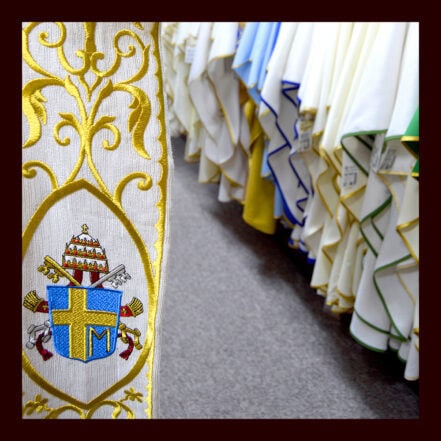
The motifs embroidered on vestments have for centuries emphasized the content of the mystery being celebrated:
- the IHS symbol refers to the Eucharist,
- the motifs of the cross remind us of Christ’s sacrifice,
- and the images of Mary point to the role of the Mother of God in the history of salvation.
Each ornament carries its own language of symbols.
Types of liturgical vestments and their function
Chasuble
The most recognizable vestment of the celebrant. It symbolizes Christ’s love covering human weakness.
Its cut, lines, and placement of decorations are intended to emphasize the dignity of the celebration — not through exaggeration, but through harmony of form.
Stole
The most important sign of the priesthood.
Worn during all sacraments and liturgical activities, it indicates unity with Christ’s mission. Its motifs often refer to the Eucharist, the cross, or biblical symbols.
Dalmatic
The deacon’s vestment, open and light.
The design is usually more subtle, but remains consistent with the rest of the vestments.
Cape
Used during solemn vespers, processions, and blessings.
Its presence emphasizes moments of communal prayer that require a special setting.
Veil
Used during the blessing with the Blessed Sacrament.
Its decoration most often refers to the Eucharist, the host, or rays of glory.
The symbolism of liturgical colors
Colors are not decoration—they are a theological commentary on the liturgical season.
Although we will not describe them in detail in this article, it is worth noting that
- each color has its own symbolism,
- their use is strictly defined in liturgical regulations,
- and the vestment should harmonize with the character of the given period.
Why does the quality of workmanship matter?
The liturgy is a space where beauty is meant to lead to God.
Delicate finishes, precise embroidery, elegant cut, and consistency of motifs create a whole that speaks louder than advertising: it shows respect for holiness. A vestment made with attention to detail is not a decoration for the celebrant alone — it is an expression of concern for the prayer of the entire community.
Summary
Liturgical vestments are one of the most important signs present during the celebration of the Eucharist. They do not only serve an aesthetic function — they are a tool of catechesis, a symbol of office, and a vehicle of theological beauty. Their form and decorations help us enter into prayer, and a well-chosen vestment is a silent but powerful testimony to what is most important in the liturgy.