
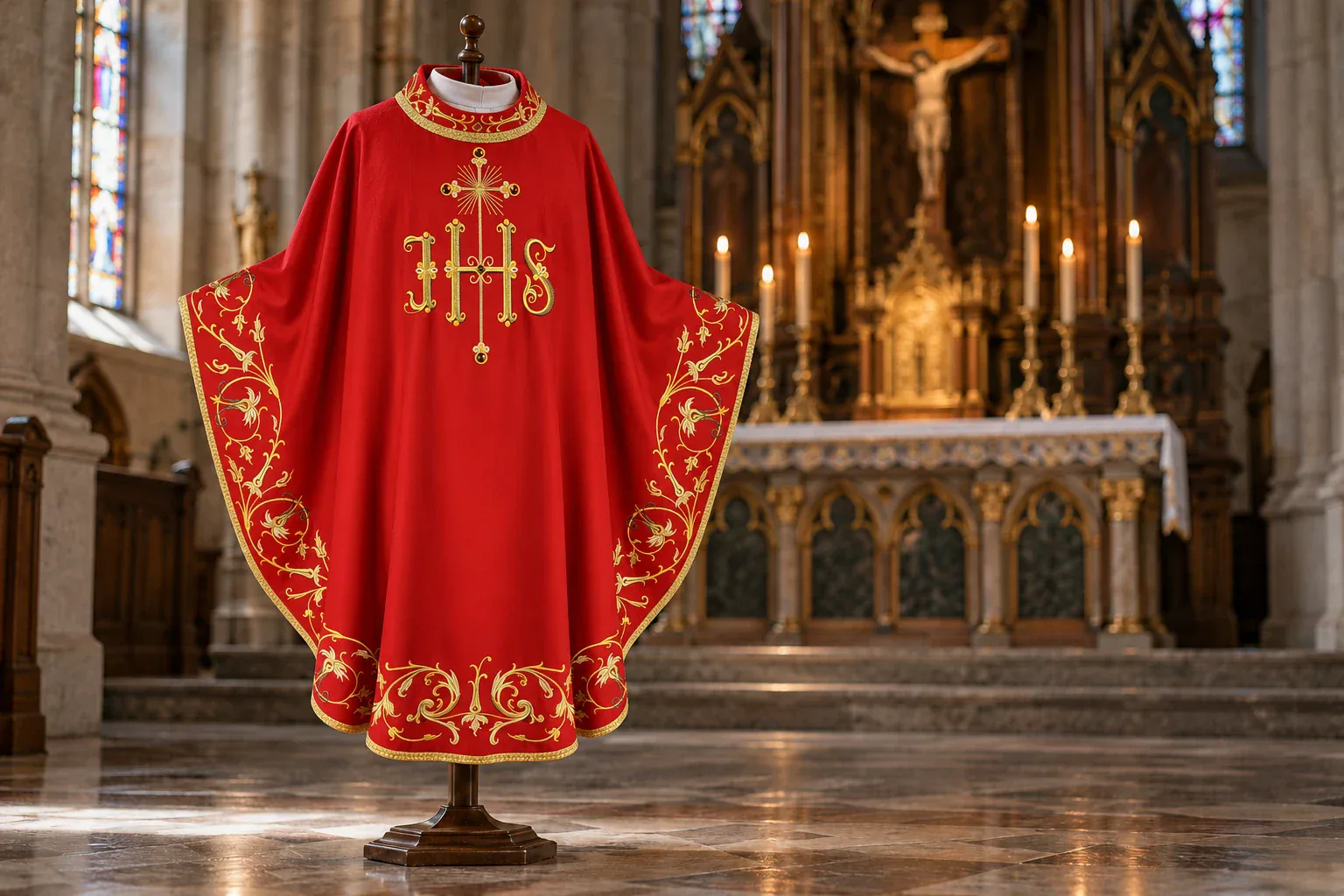
The red chasuble symbolises the blood of Christ, the witness of martyrs and the fire of the Holy Spirit. In the Roman Catholic liturgy, it is used, among other occasions, on Palm Sunday, Good Friday and the Solemnity of Pentecost, as well as during celebrations in honour of the Passion of the Lord, the Apostles, Evangelists and holy martyrs. Its use follows the liturgical regulations and the character of the particular celebration.
The same colour therefore accompanies both reflection at the cross and the joy of Pentecost. To interpret it correctly, one must consider the content of the liturgy being celebrated: the readings, prayers and mystery experienced by the Church on that day.
Since 1994, our workshop has been creating liturgical vestments, focusing on careful workmanship, legible embroidery and well-balanced ornamentation. Chasubles made in Wrocław are intended for ministry in parishes, chapels and religious communities. When choosing them, both the requirements of the celebration and the priest’s comfort and the durability of the finish are important.
The guide below explains when to prepare a vestment in red, how to understand its symbolism and what to consider when supplementing a sacristy’s equipment. It also helps distinguish the rules concerning Good Friday, Confirmation and particular feasts.
What does the red chasuble mean in the liturgy?
The blood of Christ and love expressed through sacrifice
Red evokes the blood shed by the Saviour and His sacrifice on the cross. In this context, it helps us understand the Passion of the Lord as an expression of love that remains faithful to the end. This is why the colour is especially associated with celebrations connected with the cross and redemption.
This meaning may be emphasised by embroidery depicting a cross or other symbols referring to Christ. The decoration should be clear, maintain proper proportions and remain subordinate to the sacred purpose of the vestment. Its role is to support concentration and present the content of the faith.
The witness of holy martyrs
In celebrations in honour of martyrs, red recalls their fidelity to Christ, confirmed by giving their lives. It connects their witness with the sacrifice of the Saviour. It also helps us see that the liturgical commemoration of a saint leads to the glorification of God, whose grace strengthened them in faith.
The fire of the Holy Spirit
During Pentecost, the meaning of red directs attention to the fire of the Holy Spirit. The account of Pentecost in the Acts of the Apostles describes tongues as if of fire resting on the disciples. This image is associated with God’s presence, the transformation of the heart and the strengthening needed to proclaim the Gospel. Benedict XVI also recalled the symbolism of fire as a love that transforms a person in his homily for Pentecost.
You can find a broader discussion of the individual colours in our guide:
Liturgical colours – their meaning and use in the celebration
When is a red chasuble used?
The basic rules are set out in General Instruction of the Roman Missal, no. 346. When preparing a particular celebration, the liturgical calendar and the rubrics for the relevant formulary should also be taken into account
| Celebration | Use of red vestments |
|---|---|
| Palm Sunday, also known as Passion Sunday | Red is the liturgical colour for this day. |
| Good Friday | The priest wears red vestments during the Celebration of the Passion of the Lord. |
| The Solemnity of Pentecost | Red accompanies the celebration of Pentecost. |
| Celebrations in honour of the Passion of the Lord | It is used in accordance with the relevant formulary. |
| The principal feasts of the Apostles and Evangelists | Red generally applies, subject to the exceptions indicated in the liturgical books. |
| Celebrations in honour of holy martyrs | Red is appropriate for the celebration being held in honour of a martyr. |
Palm Sunday and Good Friday
Palm Sunday combines the commemoration of Jesus’ entry into Jerusalem with reflection on His Passion. When preparing the vestments, it is worth considering the celebration as a whole, including how the liturgy begins and the ministries provided for.
The Holy Mass is not celebrated on Good Friday. The Celebration of the Passion of the Lord takes place, comprising the liturgy of the word, the adoration of the cross and Holy Communion. The priest presiding at this celebration wears a chasuble. For this reason, the term “chasuble for the Good Friday Mass” is imprecise; “chasuble for the Celebration of the Passion of the Lord” is the correct term.
Pentecost and celebrations of saints
For the Solemnity of Pentecost, one may choose a vestment embroidered with a dove, flames or a cross. However, the specific decorative motif does not replace the regulations concerning colour and is not, on its own, grounds for choosing a vestment.
In the case of Apostles and Evangelists, exceptions must be remembered. For example, the feast of St John the Apostle and Evangelist, celebrated on 27 December, has white as its colour. White also applies to the Feast of the Chair of St Peter and the Conversion of St Paul. The mere mention of an Apostle’s name in the title of a celebration is therefore not enough to determine the colour.
Red vestments for Confirmation – what should you remember?
Confirmation is associated with red because of the gift of the Holy Spirit and the strengthening of the baptised person to bear witness to the faith. Hence the frequent choice of vestments featuring a dove or other motifs referring to the action of the Holy Spirit.
However, red is not the only permitted colour for Confirmation. The Ceremonial of Bishops provides for red, white or festive-coloured vestments. It is also necessary to consider whether a ritual Mass for the conferral of Confirmation is being celebrated or whether the liturgy of a day with precedence is being used. These rules are also reflected in diocesan guidelines on preparing the celebration.
For a sacristy, this means agreeing the colour in advance with the person responsible for preparing the liturgy. The date of the sacrament, the chosen formulary and the instructions of the master of ceremonies should be known before preparing vestments for the bishop and concelebrants.
It is also worth checking whether the parish has a sufficient number of chasubles and stoles and, when a deacon is serving, the appropriate dalmatic. This preparation helps maintain order without making decisions immediately before the ceremony begins.
When purchasing a vestment for Confirmation, it is worth considering its future use. Clear, calmly composed embroidery can also serve the parish during other celebrations for which red is prescribed. The choice of a particular design should suit the needs of the community and the character of its equipment.
How do you choose red chasubles for a parish?
Cut and comfort during the celebration
When choosing a chasuble, assess its length, width, how it sits on the shoulders and the finish around the neck. The vestment should allow liturgical gestures to be performed freely and sit well over the alb.
The Gothic cut is generally wider and falls freely. When assessing it, it is worth looking at both the front and the back, as both sides are visible during various actions. A close-up photograph of the embroidery is a useful supplement to a photograph of the full garment, but should not replace it.
The Roman cut is distinguished by a more compact form and clearly defined front and back sections. Its choice may result from the parish’s tradition and the character of the paramental vestments it already owns. Both cuts require the proportions of the decoration to be carefully matched to the surface of the vestment.
Embroidered red Roman chasubles
Embroidery and quality of finish
It is worth examining the evenness of the ornament, the finishing of the edges and how the decorative band is arranged. The clarity of the main motif from a certain distance is also important. Elaborate decoration should retain an orderly composition.
The General Instruction of the Roman Missal reminds us that the beauty of vestments derives from the material and form, not from an accumulation of ornaments. This is useful guidance when purchasing too: elegance depends on proportions, quality of workmanship and the appropriateness of the symbolism.
Use throughout the year
If a parish is supplementing its basic equipment, it is worth considering a vestment with a versatile Christological motif, such as a cross. With a larger number of paramental vestments, more specific symbolism can be selected for particular celebrations.
Before placing an order, check the product description, dimensions, contents of the set and care instructions. Do not assume that every model includes the same accessories. Comparing this information makes it easier to choose a vestment that meets the sacristy’s actual needs.
How should a red chasuble be prepared and stored?
It is worth starting the preparation of the vestments by checking the liturgical calendar. The chasuble should then be examined in good light: check the edges, the area around the collar, the lining if present and areas with more elaborate embroidery. This helps identify minor damage before the celebration.
The prepared vestment should be paired with a stole and the other paramental vestments as appropriate for the ministries. Consistency may consist of a similar shade, a calm composition and a similar character of the ornaments. It does not require identical decoration on every element.
A simple order in the sacristy is helpful:
- separate vestments by colour and purpose;
- provide a place that protects the embroidery from being compressed;
- check that the equipment is complete before more important celebrations;
- store the care instructions together with the product documentation.
The cleaning method should follow the manufacturer’s information. Embroidery, lining and additional decorations may require different treatment, so a single washing method should not be used for all vestments without checking the instructions.
After use, it is worth airing the chasuble and putting it away only after ensuring that it is dry. A suitable hanger or a flat storage method should protect its shape. Avoiding tight folds over raised embroidery helps preserve the appearance of the details and prepare the vestment for the next celebration.
Frequently asked questions (FAQ)
When does a priest wear a red chasuble?
Among other occasions, on Palm Sunday, Good Friday and the Solemnity of Pentecost. Red is also used in celebrations in honour of the Passion of the Lord and in specific celebrations of the Apostles, Evangelists and martyrs. The detailed choice follows the liturgical calendar and regulations.
What does red mean during Pentecost?
It recalls the fire of the Holy Spirit, His presence and the love that transforms a person. It refers to the biblical account of Pentecost and the strengthening of the disciples to bear witness.
Is a chasuble used on Good Friday, since there is no Mass?
Yes, the priest presiding at the Celebration of the Passion of the Lord wears a chasuble. The use of this vestment follows the rites of the Good Friday celebration and does not mean that Mass is celebrated at that time.
Are red vestments always prepared for Confirmation?
No. White or festive-coloured vestments are also provided for, and the choice should be linked to the Mass formulary and the rules governing the precedence of liturgical days. It is best to agree the preparation with the master of ceremonies.
Is red required for all feasts of the Apostles?
No, there are exceptions. White applies, among other occasions, to the feast of St John the Apostle and Evangelist, the Chair of St Peter and the Conversion of St Paul. The particular celebration should therefore always be checked.
Where can you buy an embroidered chasuble for a parish?
Urbanowicz Haft Poland offers, among other products, red Gothic and Roman models. When choosing, it is worth comparing the cut, the symbolism of the embroidery, the dimensions and the contents of the set specified for the particular product.
Red in liturgical vestments recalls the sacrifice of Christ, the fidelity of martyrs and the gift of the Holy Spirit. Choosing the right chasuble combines knowledge of the liturgy with care for the worthy preparation of the celebration. At Urbanowicz Haft Poland, we focus on clear symbolism, careful embroidery and an elegant finish. When choosing a vestment for a parish, it is worth considering its purpose, ease of use and consistency with the rest of the sacristy equipment.
[LINK: Zobacz naszą ofertę ornatów czerwonych | /tag-produktu/ornaty-czerwone/]
Thanks for a well presented article. I liked the balance between getting to the point and giving the reader enough context.