
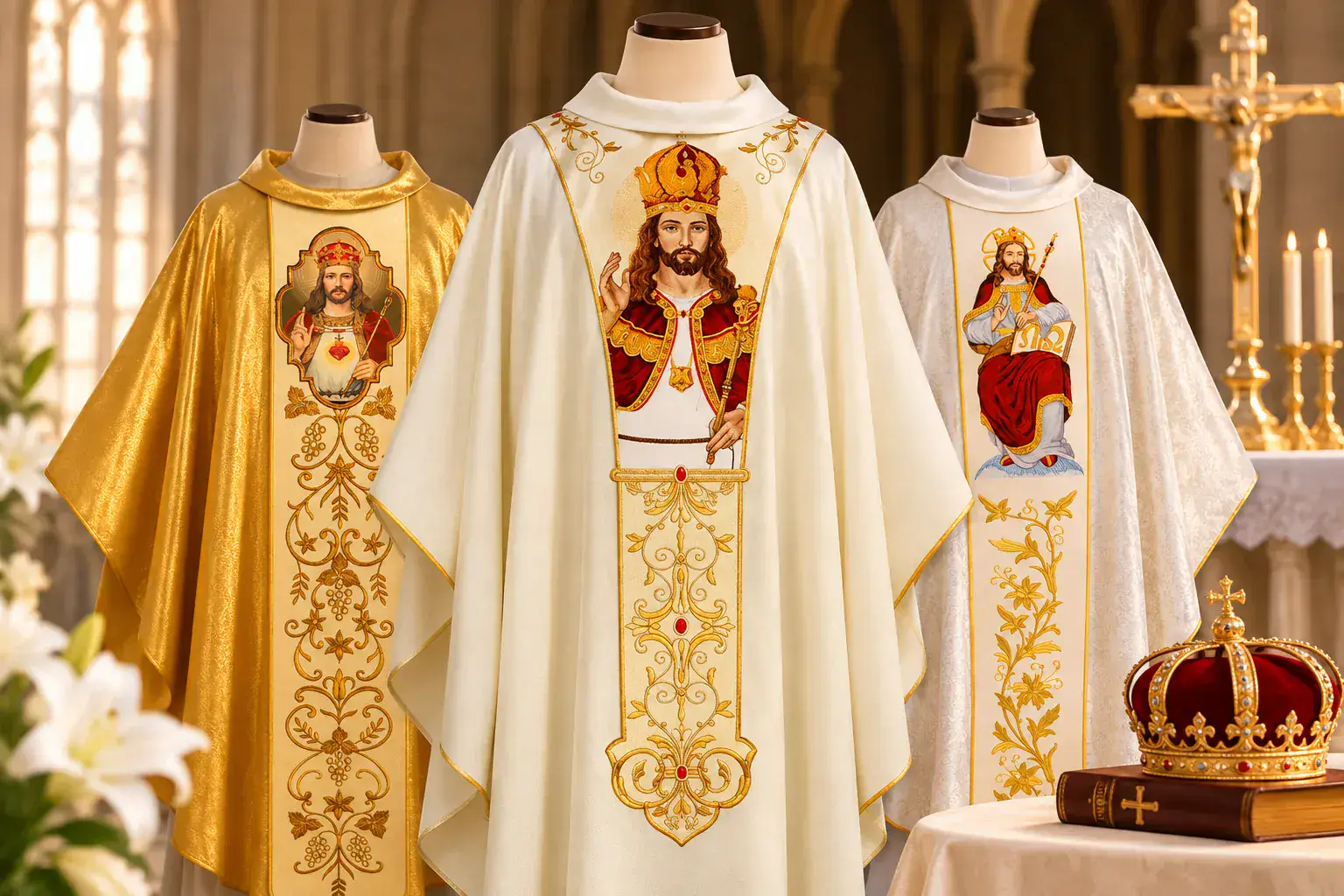
Chasubles for Christ the King should correspond to the white liturgical colour of this feast, while their decorations can emphasise the royal dignity of the Saviour. A vestment with a clearly defined cross, Christogram or depiction of Christ is a good choice. The ceremonial character of the chasuble is also determined by harmonious proportions, careful finishing and the way it falls during the celebration.
For a parish priest, sacristan or benefactor, choosing such a vestment means bringing together several needs: compliance with the liturgy, appropriate symbolism and the priest’s comfort. It is worth looking at both the overall composition and the details visible at close range. A well-chosen chasuble retains its dignified appearance in the sanctuary and allows liturgical gestures to be performed freely.
In our workshop, we take care to ensure that liturgical vestments combine the beauty of embroidery with a considered form. In Wrocław, we attach importance to detail, finishing and the consistency of the decorations. In this guide, we explain how to choose the colour, motif and cut of a chasuble for the feast of Jesus Christ, King of the Universe. We also offer guidance on what to consider before buying a vestment intended for a parish sacristy or as a gift for the community.
What colour chasuble should you choose for the feast of Christ the King?
White as the right starting point
The feast of Jesus Christ, King of the Universe has white as its liturgical colour. When choosing a chasuble, you should therefore start with a vestment in this colour. The basis is provided by the principles set out in the General Instruction of the Roman Missal, which prescribes white for celebrations in honour of Christ the Lord, except those concerning His Passion. The document also permits the use of more sumptuous vestments on more solemn days.
When shopping, it is worth examining the photographs and product description carefully. The names of shades used in catalogues do not always reflect how a vestment looks in daylight or church lighting. If a parish is looking for a chasuble to match an existing set, it may be helpful to compare it with the stole and the other vestments used during solemn celebrations.
Useful starting points when browsing models may include:
Gothic chasubles in shades of white and ecru
How should you assess gold decorations?
Gold thread can emphasise the outline of a cross, Christogram or ornament surrounding the central depiction. The best effect is achieved when it remains part of an orderly composition. It is worth assessing whether the sheen brings out the motif or makes it harder to read from a greater distance.
When buying, it is worth looking at the front and back of the chasuble. Both sides should form a coherent whole, even if the embroidery is arranged differently. The proportions of the decorative band to the width of the vestment and the way the ornament ends at the lower edge are also important.
It is also worth discussing the principles governing colours with the person responsible for preparing the celebration. A more detailed explanation of their use can be found in the guide:
liturgical colours and their significance in the celebration
The symbolism of chasubles for Christ the King — which motifs should you choose?
The cross and Christ’s royal dignity
It is worth beginning the choice of motif with the meaning of the feast itself. Christ’s kingship is linked to love, salvation and giving His life for humanity. The cross therefore remains an especially eloquent sign on a vestment intended for this day. This understanding of the Saviour’s royal dignity was recalled by Leo XIV in his homily for the feast of Christ the King in 2025, linking His reign with the love revealed on the cross.
On a chasuble, the cross may be a standalone depiction or form the axis of a broader composition. In either case, it is worth ensuring that it remains clearly visible. A small motif surrounded by elaborate ornament may be easy to see in a close-up photograph but less distinct in the sanctuary. Looking at a smaller image of the whole vestment can help — one that resembles how the faithful see it from the back pews.
The Christogram, crown and depiction of the Saviour
The IHS Christogram or Chi-Rho symbol can focus the composition on the person of Jesus Christ. A crown can emphasise the theme of the feast, especially when accompanied by a cross or a depiction of the Saviour. However, there is no need to look for a vestment containing all these elements at once. One well-emphasised motif often provides greater clarity.
For a figural depiction, attention should be paid to the proportions of the figure, the treatment of the face and the arrangement of the surrounding decorations. It is important that the image remains clear when the fabric falls naturally.
It is also worth considering whether the chasuble is intended primarily for this feast or for other celebrations in honour of Christ as well. A universal Christological motif gives greater flexibility in using the vestment throughout the year. We discuss the significance and arrangement of decorations in greater detail here:
the symbolism and aesthetics of liturgical embroidery
The cut and construction of a chasuble for Christ the King
How should you choose the form of the vestment?
The cut affects how the chasuble looks throughout the celebration. When choosing, it is worth considering the priest’s height, the width of the vestment and the way it falls on the shoulders. A model displayed on a mannequin may fall differently on someone with a different body shape, so photographs alone cannot replace checking the measurements.
In the case of a Gothic chasuble, particular attention should be paid to the freedom of movement of the fabric and the proportions of the central decoration. With a Roman-style model, the fit of the length and the arrangement of the decoration across the surface of the vestment will be important. The choice should be agreed with the priest who will use the chasuble, especially when it is a gift from parishioners.
A practical test is trying it on with an alb. This makes it possible to assess the position of the neckline, the length of the front and back, and how the vestment behaves with the arms folded and extended. The chasuble should retain its proper position without needing frequent adjustment.
How can you recognise careful finishing?
When assessing the workmanship, examine the evenness of the embroidery, the edges, bindings and points where elements are joined. The outlines of the decorations should be clear, and the surrounding surface should be neat. It is also worth checking that the weight of the decoration does not cause unwanted distortion of the vestment.
If the model has a lining, it is worth asking about its finishing and care recommendations. The way decorative elements are sewn in at the neckline is also important, as this area is regularly touched when the vestment is put on and removed.
Before buying, confirm what is included in the set. A stole, cover or other accessories should be specified in the description of the particular product. It is also worth keeping the cleaning instructions — proper care helps preserve the appearance of the embroidery and the shape of the chasuble for many years of use.
How should you prepare a chasuble for the feast of Christ the King?
Inspecting the sacristy before buying
It is best to begin preparations by examining the vestments already kept in the parish. The appropriate chasuble may only need cleaning, a minor repair to the binding or a replacement stole. This inspection helps establish the actual need and plan the purchase thoughtfully.
In 2026, the feast of Jesus Christ, King of the Universe falls on 22 November. It is worth checking the condition of the selected vestment and the time needed to prepare it well in advance.
The chasuble should be examined after being hung up, in good lighting. Check the neckline, lower edge, embroidered surface and the condition of the lining, if there is one. Creases should be removed in accordance with the manufacturer’s recommendations, taking the type of decorations into account.
When there are several celebrants, it is worth establishing the availability of vestments for all the priests in advance. This makes preparing the sacristy easier and avoids having to look for missing items just before Mass.
What should be agreed when buying a gift for a parish?
The benefactor should agree the cut, measurements and preferred symbolism with the parish. It is also worth checking whether a single vestment or an addition to an existing set is needed. These arrangements help you choose a chasuble that will be used regularly.
If an embroidered dedication is planned, its wording and position should be discussed before ordering. This is a personalising addition to the vestment, so it should remain discreet and complement its intended purpose.
Before making the final decision, confirm:
- the chasuble’s measurements and whether they can be adjusted;
- the appearance of the decorations on the front and back;
- the elements included in the set;
- cleaning and storage recommendations;
- availability and the expected delivery date.
This information makes it possible to assess the purchase as carefully as the appearance of the vestment itself.
Frequently asked questions (FAQ)
Which chasubles are suitable for Christ the King?
The right starting point is a chasuble corresponding to the white liturgical colour of the feast. Among the decorations, consider a cross, Christogram or depiction of Christ. The specific motif should be chosen according to the parish’s needs and the intended use of the vestment.
Does a chasuble have to feature an embroidered crown?
There is no obligation to choose a chasuble with a crown. A vestment with a cross or Christogram may also be suitable. A crown is one possible motif for emphasising the theme of the feast.
Can you choose a chasuble with gold embroidery for Christ the King?
Yes, a white chasuble with gold embroidery can be a suitable choice. The decorations should be assessed for clarity, proportions and the coherence of the overall composition. The colour of the embroidery alone does not replace assessing the colour and intended use of the vestment.
How should you choose the right chasuble size for a priest?
Check the length, width and neckline finish. Ideally, compare the measurements with a well-fitting chasuble already used by the priest. If possible, it is worth trying it on with an alb.
Can a chasuble for this feast also be used on other days?
Yes, a suitably chosen white chasuble with a Christological motif can be used during other celebrations for which this colour is prescribed. When buying, consider how often the parish will use it. This helps determine both the symbolism and the level of detail in the decorations.
How much does a chasuble for the feast of Christ the King cost?
The price depends on the specific model, the extent of the decorations, the finishing and any personalisation. When comparing offers, it is also worth checking what is included in the set and the measurements. Confirm the current price on the selected product page or when arranging the order.
A carefully chosen chasuble combines compliance with the liturgy, clear symbolism and the priest’s comfort. Before buying, it is worth paying attention to the proportions of the embroidery, the measurements and the quality of the finishing. At Urbanowicz Haft Poland, we have been paying attention to the detail of vestments intended for celebrations since 1994. When choosing a model for a parish, also consider its future use and care requirements so that it can serve the community for many years.