
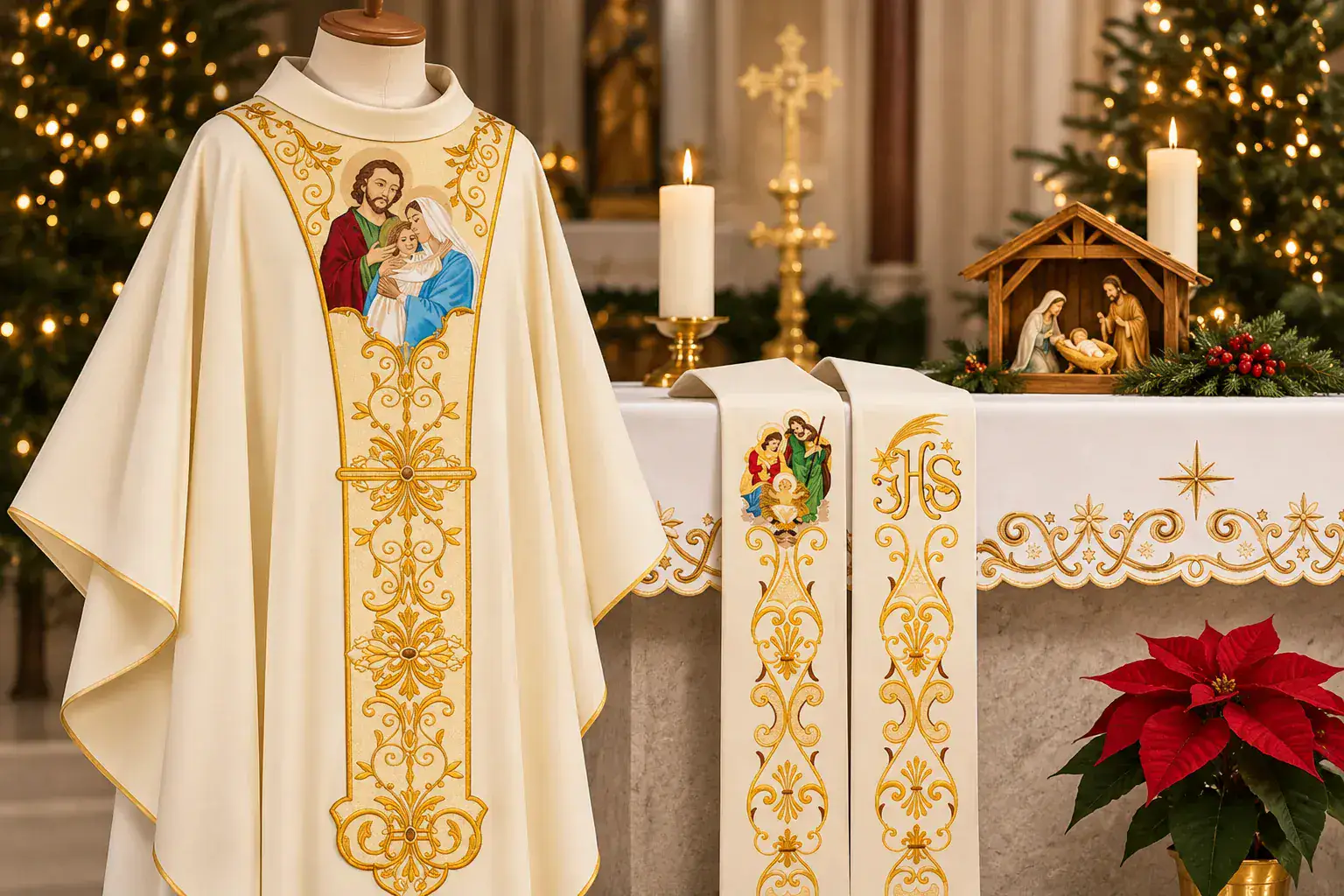
Christmas in the parish: preparing vestments and textiles
Liturgical vestments for Christmas are best prepared together with all the equipment needed for the celebration: altar cloths, chalice linen, and vestments for concelebrants and the deacon. The starting point should be the order of the celebrations, the number of ministers, and an inspection of the parish sacristy. Only then can you sensibly decide which items need refreshing, repairing or replacing.
It is worth starting preparations several weeks before Midnight Mass. This leaves time to check measurements, care for the fabrics in accordance with the maker’s recommendations, and calmly choose any missing textiles. It also helps avoid a situation where a beautiful chasuble is ready, but the correct stole, a clean corporal or an altar cloth suitable for the altar is missing.
In our workshop, we create sacred vestments and textiles, taking care over workmanship, clear symbolism and meticulous finishing. When preparing equipment for a parish, it is worth viewing it as a whole serving the liturgy.
The guide below helps you plan purchases and organise the work of the sacristy. It distinguishes the principles relating to the celebration from aesthetic choices such as the embroidery motif, degree of ornamentation or combination of individual elements. It can be useful to a parish priest and sacristan, as well as to a donor who wants to give the parish a thoughtful and necessary gift.
How should you plan preparations for Midnight Mass?
First, establish how many celebrations will take place in the parish and how many priests and deacons will participate. It is also worth including subsidiary churches and chapels if they use shared equipment. The same set cannot always be transported and prepared between successive Masses.
It is best to inspect the sacristy after taking the vestments out of their covers and laying out the textiles. Only then will you see stains, loose finishing, damaged fastenings or persistent creases. Also check whether the individual items actually match in terms of size and intended use.
A practical division of the preparations could be as follows:
- Several weeks beforehand: inspect the equipment, measure the altar and lectern cover, and establish any shortages and the budget.
- Once the celebrants have been confirmed: prepare the appropriate number of vestments and confirm what the visiting priests will bring.
- During the final week: check cleanliness, completeness and storage arrangements.
- Before the celebration: lay out the equipment according to the agreed order and check the spare set.
When ordering new items, confirm current availability and the lead time. This applies especially to products requiring size adjustments or personalisation. It is worth agreeing the preparation time before deciding on a donation.
Vestments for the celebrant, concelebrants and deacon
The primary liturgical colour for the Nativity of the Lord is white. The priest wears the chasuble over the alb and stole. Elaborate embroidery depicting the Nativity is not a requirement for using the vestment at Midnight Mass — the choice of depiction remains an aesthetic decision.
Liturgical vestments for Christmas should therefore first be chosen according to their purpose and fit, and only then according to their symbolism. The chasuble should drape well over the alb and allow the priest to perform gestures freely during Mass.
Matching the chasuble and stole
Before the celebration, it is a good idea to try on the complete set. Check the length of the chasuble, how it sits around the neck, the condition of the lining, if present, and the finishing of the edges. The stole should be prepared as a separate item, even when much of it remains hidden after the chasuble is put on.
When choosing a chasuble for Midnight Mass, also assess the proportions of the ornamentation. The central motif should be clear, and its size appropriate to the cut of the vestment. A useful starting point for comparing styles is the category:
A separate checklist for concelebration
For each concelebrant, plan an alb, stole and chasuble, along with any other necessary items of liturgical clothing. GIRM 209 permits concelebrants other than the principal celebrant to omit the chasuble for a just reason, for example when there are many priests and not enough vestments.
The organisational checklist for concelebration should include:
- the confirmed number of priests;
- information about who will use the parish equipment;
- checking the sizes and condition of the prepared vestments;
- a designated changing area;
- an agreed order for putting away the vestments after the celebration.
The set can be made cohesive through a similar character of the ornamentation. You do not need to buy all the vestments at once to maintain an orderly appearance during concelebration.
When should you prepare a dalmatic?
If a deacon ministers during Mass, prepare an alb, deacon’s stole and dalmatic for him. The dalmatic is the vestment proper to the deacon; the rubrics permit it to be omitted out of necessity or because the celebration is less solemn.
Include this set in the Midnight Mass plan from the outset. The dalmatic can be matched to the celebrant’s chasuble through a similar composition of ornamentation, while maintaining the distinctiveness of both vestments.
Altar cloth, chalice linen and lectern cover
Textiles should be prepared according to their function. An altar cloth is used to cover the altar, chalice linen is associated with preparing for and celebrating the Eucharist, and a lectern cover can complement the décor.
| Item | What to check before the celebration |
|---|---|
| Altar cloth | Dimensions, cleanliness, condition of the edges and how it sits on the altar |
| Corporal | Cleanliness, condition of the fabric and readiness for laying out |
| Purificators | A number suited to the prepared chalices and the course of the celebration |
| Pall | Cleanliness and suitability for the chalice being used |
| Lavabo towel | Prepared separately on the credence table |
| Lectern cover | Dimensions, stability and unobstructed access to the book and microphone |
| Spare textiles | Availability in the designated place in the sacristy |
How do you choose an altar cloth for Christmas?
The altar should be covered with at least one white altar cloth whose form, size and ornamentation are suited to its construction. A Christmas embroidery motif is an aesthetic option.
Before choosing an altar cloth, measure the length and width of the mensa and determine the desired drop. View the altar from the nave: it is important to consider where the embroidery will be placed and whether it will be clearly visible. Existing altar ornamentation should also be taken into account.
How many sets of chalice linen should you prepare?
The number of items is determined by the celebration plan and the vessels being used. One retail set does not necessarily meet all the needs of a particular Mass. When several celebrations follow one another, it is sensible to set aside a clean spare set in advance.
Embroidered cover or printed cover for lectern?
The choice depends on the intended effect and the rest of the sanctuary furnishings. An embroidered cover can be paired with a detail on the altar cloth or vestments. A printed cover for lectern is a product made using thermal sublimation printing.
Before purchasing, check the width, length and method of attachment. The cover should not hinder use of the lectern.
How can you combine motifs without excessive ornamentation?
The easiest approach is to start with one item that will define the character of the set. This could be a Christmas chasuble depicting the Nativity of the Lord, or an altar cloth with a clear Eucharistic motif. Choose the remaining textiles to maintain balance.
Not every item has to repeat the same scene. A large depiction on the chasuble can be combined with a calmer altar-cloth ornament and a small symbol on the pall. Above all, compare the scale of the embroidery, its placement and its visibility from the back of the church.
Frequently asked questions (FAQ)
Which liturgical vestments should be prepared for a priest for Christmas?
For the celebrant, prepare an alb, stole and chasuble, along with any other necessary items of liturgical clothing. The primary colour of the celebration is white; the ornamentation can be chosen to suit the character of the parish furnishings.
Must a chasuble for Midnight Mass depict the Holy Family?
There is no such requirement. You can choose a vestment with another appropriate motif, while observing the principles relating to liturgical colour and purpose.
Must all concelebrants have identical chasubles?
Concelebration is not dependent on having identical chasubles. When preparing the equipment, it is worth ensuring that it is appropriate and that the set is visually cohesive.
How to measure an altar before ordering an altar cloth?
Measure the length and width of the mensa and determine the drop length on each side. In the order, clearly distinguish the altar dimensions from the desired dimensions of the finished altar cloth.
What is the difference between a printed cover for lectern and an embroidered one?
A printed cover for lectern features an image produced using thermal sublimation printing. On an embroidered cover, the ornamentation is made with thread, so the two products differ in production technique and the appearance of the detail.
When should you order equipment for Christmas?
It is worth reviewing your needs several weeks before the celebration. The exact purchasing date depends on product availability, the extent of any adjustments and the confirmed lead time.
Well-prepared vestments and textiles help maintain order in the sacristy and provide a dignified setting for the celebration. Start by reviewing the equipment, establishing the number of ministers and checking the measurements. Then replace only those items the parish genuinely needs. At Urbanowicz Haft’s workshop in Wrocław, we take care over the workmanship and detail of sacred vestments and textiles.
Choose vestments and textiles for the celebration of the Nativity of the Lord