
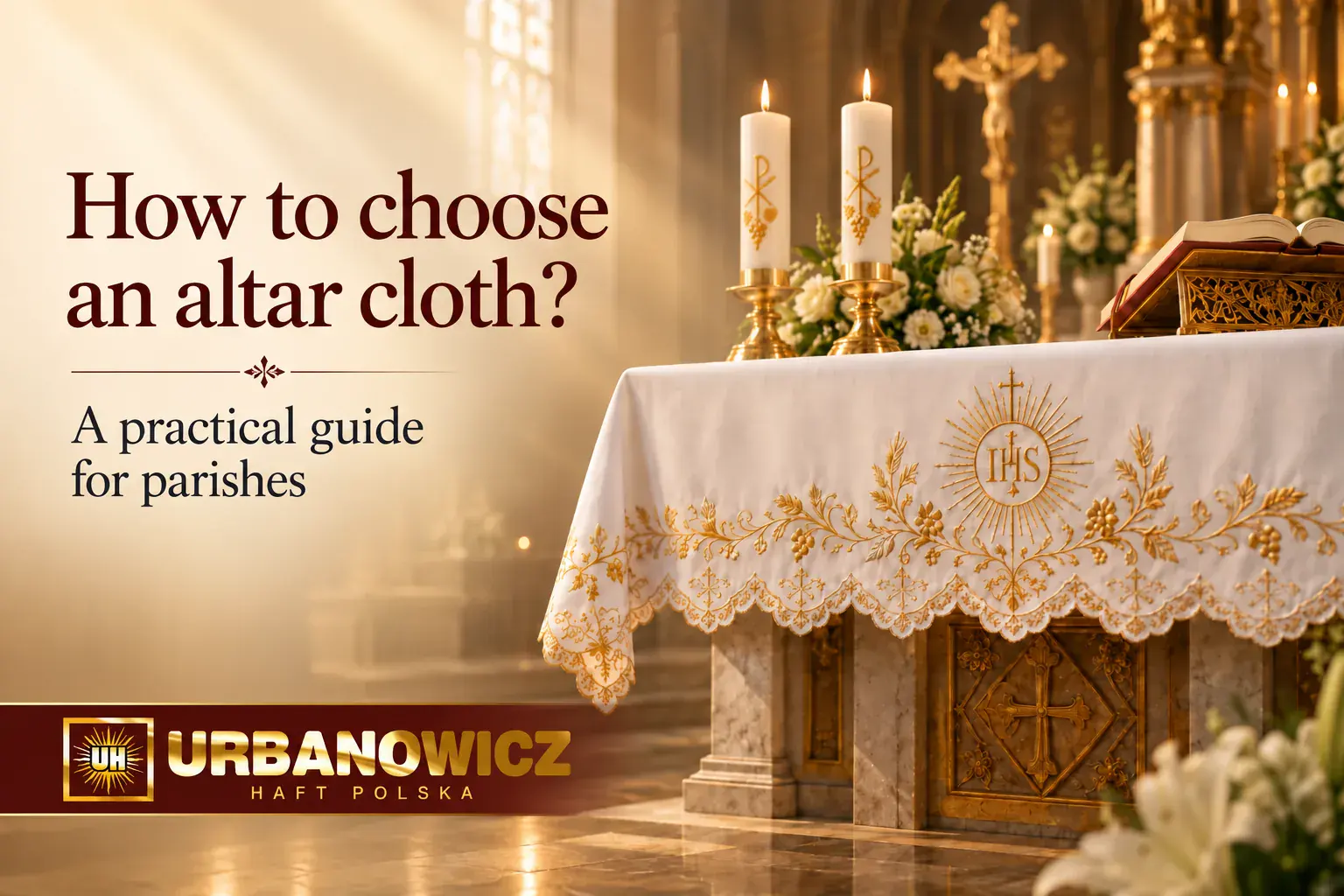
How to choose an altar cloth?
How to choose an altar cloth, so that it fits the altar properly, hangs well and enhances the dignified character of the liturgical space? The most important considerations are the correct dimensions, the appropriate finish, quality workmanship and a design suited to the character of the church and the celebrations held there. An altar cloth should not be chosen solely on the basis of its appearance – its functionality during everyday use is equally important.
In our workshop, we prepare sacred textiles for churches, chapels and communities. From experience, we know that most problems when ordering an altar cloth result not from choosing a design, but from measuring the altar mensa incorrectly or failing to account for the length of the drops.
That is why, before purchasing, it is worth measuring the altar carefully, considering from which sides the altar cloth should be visible and deciding whether subtle decoration, a richer eucharistic motif, a Marian design or a more universal altar cover for year-round use would be the best solution.
How to choose an altar cloth based on its dimensions?
Measuring the altar correctly is the first and most important stage in choosing an altar cloth. Even the most carefully made altar cover will not look right if its proportions are not matched to the mensa.
How to measure an altar
First, measure the following:
- the length of the altar mensa,
- the width of the mensa,
- the planned length of the drop on the left-hand side,
- the planned length of the drop on the right-hand side,
- any drop at the front of the altar.
For example, if the altar top is 250 cm long and the altar cloth is to have a 25 cm drop on each side, the total length of the finished altar cloth should be approximately 300 cm.
For the width, you need to determine whether the fabric is only to cover the surface of the mensa or should also hang partially over the celebrant’s side or the front.
It is not advisable to rely solely on the dimensions of an old altar cloth. If it was made many years ago, it may have changed during use or may not have had optimum proportions from the outset. The safest solution is to measure the altar itself again.
How long should an altar cloth drop be?
There is no single universal dimension suitable for every altar. The length of the drop should be matched to its construction, width and the style of the sanctuary.
On a monumental altar, a drop that is too short may look out of proportion. Conversely, on a small chapel altar, very long ends may unnecessarily dominate the entire composition.
It is therefore worth considering the altar as a whole. The altar cloth should form a harmonious composition with it, rather than appearing to be an element chosen at random.
Which altar cloth should you choose – embroidered, openwork or classic?
Once the dimensions have been established, you can move on to choosing the type of decoration. Contemporary altar textiles offer many possibilities in this respect – from very discreet embellishments to elaborate sacred compositions.
Altar cloth with front decoration
This is one of the most classic solutions. The decorative motif is placed in the most visible part of the altar cloth and becomes an integral element of the sanctuary’s décor.
It may depict, among other things:
- a cross,
- a chalice and host,
- grapevines and ears of wheat,
- the IHS monogram,
- the Lamb of God,
- floral ornaments,
- Marian symbols,
- motifs relating to specific celebrations.
When choosing a design, it is worth considering the architecture of the interior. Classic and clearly defined designs often look good in richly decorated churches. More restrained compositions may be more suitable for modern churches.
Altar cloth with side embroidery
Another solution is to place the decoration mainly on the side sections of the covering. This allows the front of the altar to retain a calmer composition while giving the whole piece an elegant finish.
see altar cloths with side embroidery
This solution may be particularly appealing for altars whose fronts already feature decorative elements – carving, a stone texture, mosaic or other details that should not be concealed.
Openwork altar cloth
A cutwork finish gives textiles a sense of lightness and creates a highly precise decorative effect. It is particularly visible against the altar front.
With more elaborate designs, it is worth exercising restraint. The altar remains the central place of the celebration, so the decoration should enhance its character rather than distract attention from the liturgy.
How to match an altar cloth design to the liturgy?
The design of an altar cloth may be universal or refer to a specific symbolism. The choice depends primarily on whether the altar cover will be used throughout the year or for selected celebrations.
Universal altar cloth for year-round use
If a parish is looking for a single altar cloth for frequent use, eucharistic symbols and classic liturgical ornaments are a safe choice.
A chalice, host, vine, ears of wheat, cross or IHS monogram remain clear regardless of the season of the liturgical year.
Such an altar cloth can be used both during ordinary celebrations and many parish ceremonies.
Eucharistic altar cloth
Eucharistic motifs are among the most natural decorations for altar textiles. They refer directly to the Eucharist and consequently retain a timeless character.
Both individual symbols and more elaborate compositions featuring a chalice, host, vine and ears of wheat are good choices.
Marian altar cloth
In parishes dedicated to Our Lady or places particularly associated with Marian devotion, it is worth considering an altar cloth with appropriate symbolism.
Marian motifs may be used during feasts of the Blessed Virgin Mary, May and October devotions, patronal feasts and other parish celebrations.
The most important considerations here are the clarity of the symbol and the preservation of an appropriately solemn character. A well-designed pattern does not require a large number of elements – often, a few carefully positioned details produce a much better effect than a highly elaborate decoration.
What should you look for when choosing an altar cloth?
Aesthetics are important, but for textiles used in a church, practical considerations are equally significant.
Quality workmanship
An altar cloth should be carefully finished around its entire circumference. Even edges, precise decorative workmanship and maintaining the symmetry of the design are particularly important.
On large altar cloths, even a slight shift in the ornament may be clearly visible. That is why it is worth paying attention not only to the design itself, but also to the precision of its placement.
Ease of care
An altar cover is used regularly, so its care should not be unnecessarily complicated. Practicality is particularly important in larger parishes, where textiles are changed and washed frequently.
Before purchasing, it is worth checking the recommendations concerning:
- washing,
- ironing temperature,
- drying,
- storage.
A large altar cloth is best stored in a way that limits the formation of deep creases, particularly in decorated areas.
Durability of the decoration
An altar cloth may be used for many years, so the quality of the finishing details is important. Carefully made decoration should retain its clarity and elegance despite regular use and maintenance carried out in accordance with the manufacturer’s recommendations.
In our workshop in Wrocław, we pay particular attention to the finish and proportions of the designs. In sacred textiles, detail matters – both when viewed up close and from the far end of the church nave.
How to match an altar cloth to other textiles?
It is best to treat the sanctuary furnishings as a cohesive whole. The altar cloth does not have to be identical to every other element, but it is helpful for the individual textiles to share a common style.
You can repeat:
- the same eucharistic symbol,
- a similar ornament,
- a cross motif,
- the style of the finish,
- a similar degree of decoration.
This allows the altar cloth, linens and other altar furnishings to form a harmonious composition.
It is also worth paying attention to chalice linen, including the corporal, purificator and pall. It does not have to reproduce the altar cloth’s design exactly. It is enough for it to relate to it stylistically and retain a similar character of workmanship.
This approach makes the chancel look elegant and orderly, without creating an impression of excessive decoration.
Made-to-measure altar cloth – when is it worth ordering one?
In practice, many altars require individually selected dimensions. This applies particularly to older churches, historic altars, large mensae and structures made to an individual design.
A made-to-measure altar cloth allows you to match precisely:
- the length,
- the width,
- the length of the side drops,
- the position of the decoration,
- the proportions of the design in relation to the altar front.
This is particularly important when the ornament should be positioned precisely in a specific place.
For unusual altars, before placing an order it is worth taking not only measurements, but also a photograph of the entire mensa and its front. This makes it much easier to assess the correct proportions of the decoration.
Urbanowicz Haft Poland makes sacred textiles in its workshop in Wrocław. We prepare products for Polish parishes and communities, as well as customers in other European countries.
Frequently asked questions (FAQ)
How to choose the right altar cloth size?
Measure the length and width of the mensa and add the planned drops. It is not advisable to rely solely on the dimensions of an old altar cloth – accurately measuring the altar provides much greater certainty that it will fit correctly.
How to measure an altar before ordering an altar cloth?
Measure the length and width of the top, then determine how far the altar cloth should hang at the sides and front. With an unusual construction, it is also worth taking a photograph of the altar from the front.
Which altar cloth design should you choose for year-round use?
The most universal options are classic eucharistic motifs such as a chalice, host, ears of wheat, vine, cross or IHS. They are not associated exclusively with one particular celebration and can be used for most of the liturgical year.
What is the difference between an altar cloth with side embroidery and a traditional one?
The difference mainly concerns the placement of the decoration. On an altar cloth with side embroidery, the main decoration is located on the side sections, allowing the front to remain more restrained and not obscure the decorative part of the altar.
Is it worth ordering a made-to-measure altar cloth?
Yes, particularly if the altar has unusual proportions, a large mensa or a decorative front. A bespoke size allows the drops to be positioned correctly and the design to be placed in relation to the altar’s construction.
Which altar cloth should you choose for Marian celebrations?
A covering with a Marian motif would be a good choice, for example featuring the monogram of Mary, lilies, a crown, stars or other traditional symbolism. It is important that the composition retains liturgical solemnity and harmonises with the chancel décor.
How should you care for an altar cloth?
Follow the care instructions assigned to the particular product. Particular care should be taken when ironing the decorative parts of the altar cloth and when storing it.
Where can you buy an altar cloth?
It is worth choosing a workshop specialising in sacred textiles that offers made-to-measure options and has experience in designing liturgical patterns. This makes it easier to select both the right proportions and the appropriate character of the decoration.
A good altar cloth should last for years
When choosing an altar cloth, it is worth starting with carefully measuring the mensa and only then deciding on the type and placement of the decoration. A well-chosen altar cover should be practical, carefully made and harmonise with the sanctuary space. The right proportions and refined detail help preserve the elegance and due solemnity of the place of celebration.